E2MBrazil Entry Decision System™USE ANY TOOL DIRECTLYVIEW ENTRY BRIEF →
E2M RESEARCH · ENTRY ECONOMICS INDEX 2026

Compare Brazil entry models by commitment—not by a fake score.

Free public planning tool.

Direct sales, distributors, representatives, EOR, a Brazilian entity and hybrid models create fundamentally different economics. This index makes the trade-offs explicit before you commit capital or structure.

UNDERSTAND→ASSESS→DECIDE→DESIGN→MODEL→PLAN
E2M BRAZIL ENTRY ECONOMICS™MODEL LAYER · 05
THREE SIMPLE MOVESChoose. Understand.
Refine only if needed.
01
Choose the commitment levelValidation, lean local team or permanent presence.
02
See the capital range6 months, 12 months and steady monthly burn.
03
Add real quotes if you have themLeadership, GTM and entity setup remain explicit—not invented.
SELECTABLE CURRENCY · BRL TRACEABILITY2026 BENCHMARK LAYER
MODEL COMPARISON

Six entry architectures. Seven dimensions. Zero composite score.

A single ranking would hide the decision. E2M keeps each dimension separate: what you pay, what becomes fixed, how quickly you can operate, what you must unwind, where control sits, what talent is required and how much operating machinery you create.

No composite score.“Low / medium / high” scoring can look precise while hiding assumptions. Where E2M has a defensible number, we show it. Where economics are contractual or quote-driven, we say so.
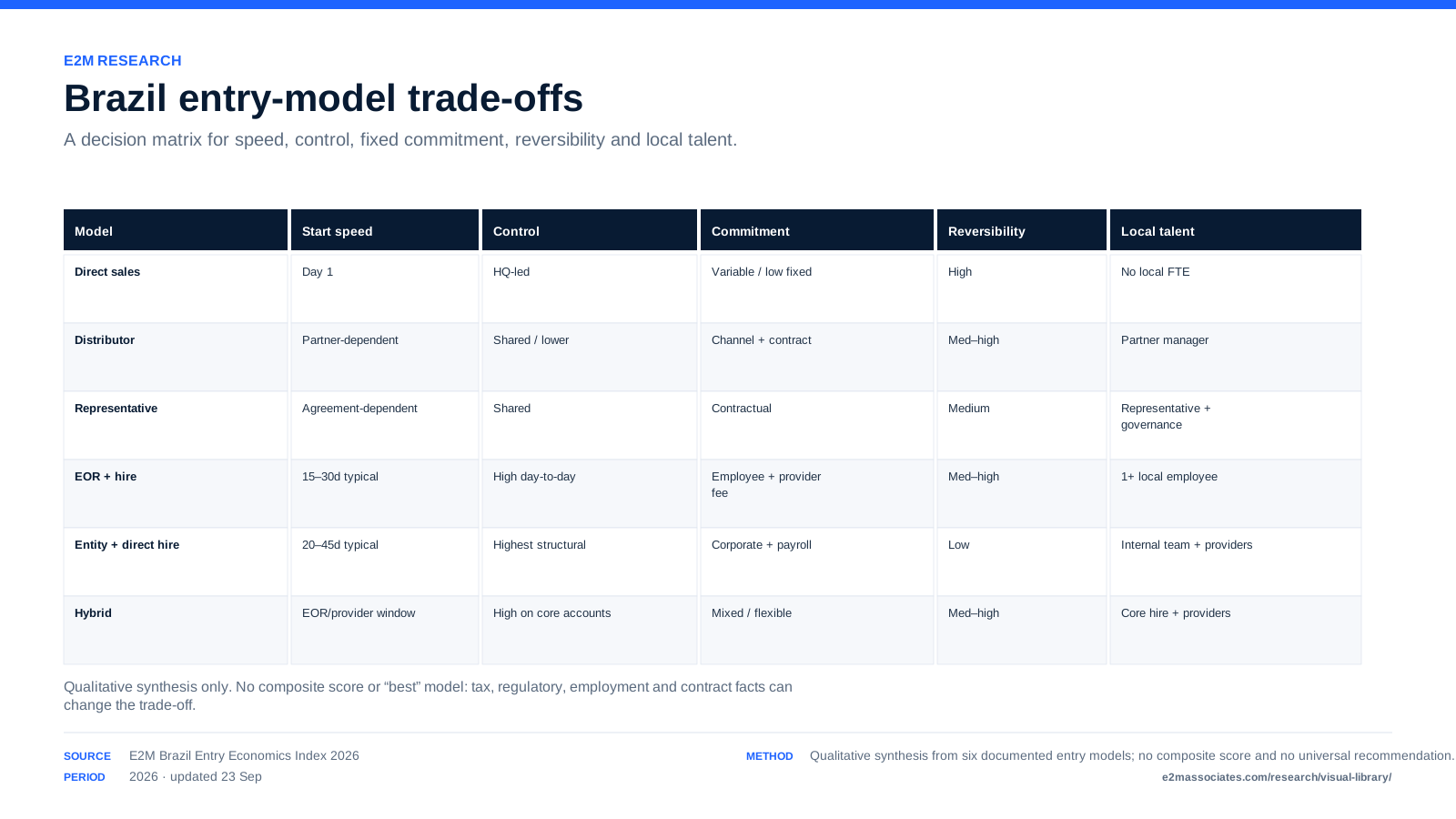
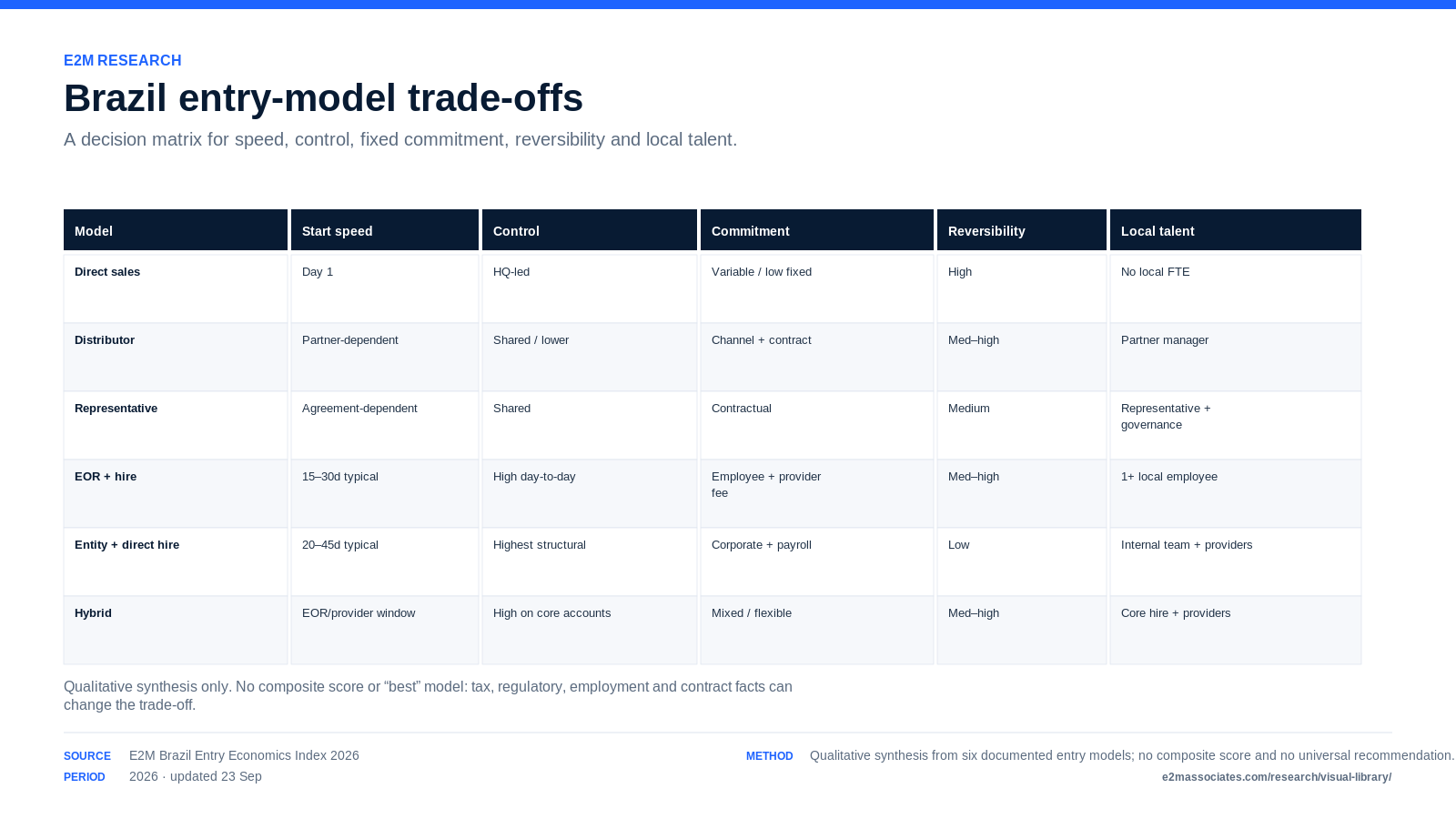
Matrix compares six Brazil entry models across speed, control, commitment, reversibility and local talent needs.
Brazil Entry-Model Trade-Off Matrix 2026
Source: E2M Brazil Entry Economics Index 2026 · Period: 2026 · updated 23 Sep · Method: Qualitative synthesis; no composite score or universal best model.
Entry modelUpfront economicsMonthly commitmentSpeed to operateReversibilityLocal controlTalent requiredOperational complexity
Direct sales from abroadDIRECTNo entity by default; commercial setup is quote-driven.No mandatory Brazil payroll; GTM/travel/support stay variable.Day 1; 1–7 days for validation motion.Highest structural reversibility.HQ control; limited local ownership.HQ senior seller; no local FTE required.Low local stack; cross-border/regulatory issues may still matter.
Distributor / resellerDISTRIBUTORPartner search, diligence, contracting and enablement.Main economic give-up is channel margin/discount; fixed payroll can stay low.Partner-selection / enablement dependent.Contract, inventory and exclusivity must be unwound.Shared / lower direct customer control.Strong partner manager.Channel, pricing, import/service and compliance interfaces.
Local commercial representativeREPRESENTATIVESearch, diligence and contract design; no universal setup benchmark.Contract-specific; often performance-linked.Can start once representative and agreement are ready.Contract / representation-law exit considerations.Company keeps offer authority; coverage depends on representative.Partner-management capability.Territory, exclusivity, commission and classification design.
EOR + local employeeEORRecruiting/onboarding + provider setup.~R$13.95k/mo for an R$8k first-seller illustration before optional benefits.7–14 days best case; 15–30 typical.Provider + employment offboarding.High day-to-day role control.1+ local employees + HQ manager.Employment/provider interface without owned entity.
Brazilian entity + direct employmentENTITYForeign-shareholder documents + incorporation/professional setup; quote-driven.~R$11.98k/mo statutory for R$8k salary before benefits + corporate/accounting stack.7–15 business days best case after docs; 20–45 calendar typical.Corporate, tax, payroll and contract wind-down.Highest structural control.Local team + finance/payroll/accounting coordination.Highest recurring governance/compliance stack.
Hybrid: EOR/local closer + outsourced launchHYBRIDRecruiting/onboarding + outsourced launch setup.~R$38.95k/mo illustrative first 90 days before benefits/workspace.Usually within EOR/provider onboarding window.Flexible outsourced layers; employment/provider obligations remain.High on core accounts; flexible execution capacity.Core local owner + provider-management skill.More interfaces, less fixed structure than full internal build.
MODEL-BY-MODEL

The economic engine behind each route

The right model depends on the bottleneck you are solving now—not the final organization you may build later.

01 · ECONOMIC ENGINE

Direct sales from abroad

No mandatory Brazil payroll. Local GTM, travel, translation and support remain variable / quote-driven.

BEST WHEN
Testing demand before fixed local structure is justified.
BREAKS WHEN
When customers require local invoicing, local service levels, local employment or regulated/import infrastructure.
02 · ECONOMIC ENGINE

Distributor / reseller

Fixed local payroll may remain low; the main economic give-up is usually embedded in channel margin/discount and partner economics.

BEST WHEN
When local channel reach, import capability or sector relationships matter more than owning every customer interaction.
BREAKS WHEN
When the company needs direct customer data, tight pricing control or a proprietary local sales motion.
03 · ECONOMIC ENGINE

Local commercial representative

Compensation is contract-specific and often linked to commercial performance; E2M does not publish a universal commission assumption.

BEST WHEN
Relationship-led selling where local access matters but owned payroll is premature.
BREAKS WHEN
When the company needs full managerial control, deep product specialization or a scaled proprietary sales organization.
04 · ECONOMIC ENGINE

EOR + local employee

Illustrative first-seller anchor: R$8,000 salary + 35.9% provider employer-cost estimate + US$599 EOR fee ≈ R$13,952/month before optional benefits.

BEST WHEN
When local talent is needed quickly but the entity decision should remain reversible.
BREAKS WHEN
When headcount, revenue operations, regulated activities or long-term economics make an owned entity more rational.
05 · ECONOMIC ENGINE

Brazilian entity + direct employment

Illustrative first-seller anchor: R$8,000 salary × 1.4978 general-regime statutory planning factor ≈ R$11,982/month before optional benefits, plus accounting/compliance and operating stack.

BEST WHEN
When Brazil is a durable operating market and control, local contracting or scale justify fixed infrastructure.
BREAKS WHEN
When demand is still unproven and fixed commitments outrun commercial evidence.
06 · ECONOMIC ENGINE

Hybrid: EOR/local closer + outsourced launch

Illustrative first-90-day anchor: EOR first seller ≈ R$13,952/month + one observed outsourced launch scope of R$25,000/month ≈ R$38,952/month before benefits/workspace.

BEST WHEN
When the company wants speed and local ownership without prematurely internalizing every function.
BREAKS WHEN
When provider coordination becomes harder or more expensive than internalizing recurrent capabilities.
QUANTIFIED ANCHORS

Three comparable numbers—without pretending they are market averages

These examples reuse published E2M benchmarks and one explicitly labeled operating observation. They are planning anchors, not quotations.

EOR first seller≈ R$13.952 / mês

R$8.000 salary + 35,9% employer-cost provider estimate + US$599 EOR fee.

before optional benefits / other excluded layers
Direct-employment first seller≈ R$11.982 / mês

R$8.000 salary × 1,4978 general-regime statutory planning factor.

before optional benefits / other excluded layers
Hybrid launch illustration≈ R$38.952 / mês

EOR seller + one observed R$25k/month outsourced launch scope for the first 90 days.

before optional benefits / other excluded layers
DECISION RULES

Use the index to expose the next irreversible commitment

Need proof before structure?Start with direct sales or a hybrid validation motion. Do not create an entity simply because Brazil is strategic.
Need one local employee fast?EOR isolates the employment layer while the entity decision remains open.
Need channel reach or import capability?A distributor can replace fixed payroll with partner economics, but you trade away direct control.
Need durable local contracts and scale?An owned entity becomes rational when recurring local activity justifies its fixed governance and compliance stack.
METHODOLOGY

Economics first. Labels second.

The index combines official process evidence with E2M’s existing salary, employer-cost, timeline and commercial-launch benchmarks. It does not convert legal or commercial complexity into a synthetic number.

Primary / benchmark sources

Keep the 6- and 12-month calculator.The index tells you how the models differ. The scenario calculator below then models three commitment levels using the same evidence architecture.
E2M BRAZIL ENTRY ECONOMICS™Scenario calculator: 6- and 12-month capital.

Start with the operating model. The first answer is intentionally simple. Detailed assumptions stay one layer deeper.

3 operating models6 + 12 month viewSelectable currency + BRLBrowser-private
ECONOMICS WORKS STANDALONEStart here if your immediate question is budget. Choose any scenario below; no prior assessment is required.

Which plan are you evaluating?

Pick the closest one. If a previous Minimum Viable Brazil™ result exists, you may optionally use it as context.

You can switch scenarios at any time.
Select one scenario below to calculate its 6- and 12-month economics.
YOUR MODELED ECONOMICS

SELECTED SCENARIO
US$1 = R$5.16 benchmark reference
12-MONTH MODELED RANGE
6-MONTH RANGE
STEADY MONTHLY BURN
HEADCOUNT
REVERSIBILITY
OPTIONAL · ADVANCED ASSUMPTIONSOnly change what you actually know.

These fields are deliberately optional. Leaving them blank is more honest than inventing a market average. Quote inputs stay in USD; your reporting currency can be changed independently.

Applied to validation and lean scenarios when entered.
Applied to all scenarios when entered.
Applied to the permanent-presence scenario only.
Only used for the optional break-even lens.
Used for USD-denominated EOR pricing and any USD quotes you add.
Enter how many BRL equal 1 unit of your selected reporting currency.
Use a three-letter ISO-style code. Then enter BRL per 1 unit above.
Compare all three commitment levels
NEXT · SYNTHESIZETurn these decisions into one executive Brazil Entry Brief.

Combine your entry mode, minimum viable operating model and economics into a single board-ready decision summary before moving into execution planning.

BUILD MY ENTRY BRIEF →
METHODOLOGY

Simple interface. Explicit economics.

E2M keeps benchmark-backed costs separate from quote-driven workstreams so the output is useful without pretending to know what the market cannot responsibly standardize.

01Benchmark-backed

People, employment planning references, workspace and housing use the 2026 E2M benchmark layer.

02Quote-driven

Leadership, demand generation and professional entity setup stay blank until a real assumption exists.

03Scenario-specific

Each commitment level has a transparent team, employment model, footprint and soft-landing assumption.

04Decision-focused

The main question is how much additional capital and irreversibility each layer creates.

Scope and limitations. Brazil Entry Economics™ is a strategic planning model, not a quotation, financial forecast, legal/tax opinion or accounting model. Salary benchmarks exclude variable compensation unless stated. Employment costs vary by tax regime, sector, collective agreements and benefits. Published provider prices are commercial references, not independent market averages. Quote-driven workstreams are excluded unless the user supplies an explicit assumption.
FROM DECISION TO PROJECT

Continue this decision inside your Expansion Passport.

Connect this workstream with the rest of your Brazil plan, see what is still open, and decide when the project is ready for E2M execution.

Expansion EconomicsPlanning stays on this device until you explicitly share it or submit an execution request.
Plan the economics interactively. Brazil Market Entry Calculator →
NEXT STEP · OPTIONAL

Ready to make a decision about Brazil?

Tell us what you are considering. Our São Paulo team will review the request and suggest a practical next conversation.

Real work in Brazil. A local team to move it forward.

Free tools remain free and private in your browser. No assessment is transmitted unless you explicitly opt in.

Free tools remain free and private in your browser. No assessment is transmitted unless you explicitly opt in.

TALK TO US