Context & problem
Confirm the local business problem, trigger and why Brazil matters now.
A source-separated operating benchmark for the first commercial motion in Brazil — from channel choice and first meetings to local BD structure, timelines and 90-day budget architecture.
These figures describe channel presence, a software-specific sales cycle and one current E2M execution program. They are deliberately not blended into a fake “average Brazil launch.”
Channel choice depends on buyer concentration, deal complexity, product regulation and who owns the follow-up. The evidence below tells you where channels exist — not which one will convert for your offer.
| Channel | Job to be done | Best fit | Evidence basis | Watch-out |
|---|---|---|---|---|
| Local BD / account-based outreach | Create accountable local follow-up across LinkedIn, email, phone and meetings. | B2B services, SaaS, industrial and complex offers with identifiable buyers | E2M operating model + Trade.gov relationship guidance | Local owner must respond quickly and carry context across meetings. |
| Map named decision-makers, warm introductions and social selling. | Technology, professional services and large-company targeting | TIC Empresas 2025 + DataReportal 2026 context | Company/member presence is not response propensity. | |
| Relationship-led follow-up once context or permission exists. | Local follow-up and ongoing buyer/partner conversations | Trade.gov business customs + TIC Empresas 2025 | Do not interpret widespread use as permission for unsolicited bulk messaging. | |
| Partners / distributors / representatives | Transfer trust, local coverage, import capability or sector access. | Industrial, regulated, channel-led and geographically distributed markets | Trade.gov market-entry and distribution guidance | Define territory, economics, ownership, data, conflicts and after-sales obligations. |
| Events / associations | Concentrate access to niche buyers and create relationship context. | Industrial, enterprise and ecosystem-dependent categories | Trade.gov matchmaking model + E2M observed event-partner case | Event presence without pre-targeting and post-event follow-up is activity, not pipeline. |
| Paid search / paid social | Capture or create demand where category search and economics support it. | Software and categories with measurable digital intent | Agência Maximum 2026 — software-specific | Do not transfer software CPL ranges into industrial/services without validation. |
Context: TIC Empresas 2025 reports company profile/account presence of 34% on LinkedIn and 79% on WhatsApp/Telegram across surveyed Brazilian companies with internet access; information & communication companies report 63% LinkedIn presence. These are presence indicators, not conversion benchmarks.
U.S. Commercial Service guidance describes Brazilian negotiations as relationship-led, often requiring continuity and multiple meetings. E2M therefore treats the first conversation as a qualification and localization event, not a closing event.
Confirm the local business problem, trigger and why Brazil matters now.
Map stakeholders, procurement, legal/technical constraints and decision timing.
Test pricing logic, Portuguese materials, implementation, support and local references required.
Agree a specific next step: technical session, partner validation, pilot, commercial proposal or no-go.
Trade.gov notes that important business in Brazil is often relationship-led, benefits from continuity of the negotiating team and may require multiple meetings; virtual meetings are common, but should not fully replace in-person interaction for consequential relationships.
The decision is about speed, control, fixed commitment and where market learning should live. External SDR benchmarks show that internal teams also need ramp time; outsourced speed only works if knowledge is transferred back into the company.
| Dimension | Outsourced | Internal | Hybrid |
|---|---|---|---|
| Speed to start | Faster if provider already has process/data stack | Hiring + onboarding + ramp before stable output | Fast prospecting start with internal/local closing ownership |
| Control | Requires explicit ICP, qualification and reporting contract | Highest direct control | Control over closing; flexible top-of-funnel execution |
| Learning retention | Risk if insights remain with vendor | Institutional memory stays in team | Requires shared CRM and weekly learning loop |
| Fixed commitment | More reversible | Higher fixed payroll / employment commitment | Medium |
| When it fits | Validation, temporary capacity, new-market uncertainty | Proven motion with enough recurring load | Need speed now but want local ownership of buyer relationships |
The Bridge Group reports 3.0 months average ramp in a 351-company B2B sample. It is North America/SaaS-heavy, so use it to challenge “hire today, productive tomorrow” assumptions — not as a Brazil benchmark.
The observed E2M integrated program includes a dedicated SDR plus multichannel activation capacity. It is a scoped execution reference, not a universal staffing prescription.
Permanent headcount becomes more defensible when the ICP, offer, qualification rules and response ownership are stable enough that recurring workload justifies fixed capacity.
This is an E2M planning model. It is a sequence for producing evidence, not a promise that revenue closes in 90 days.
ICP, buyer, offer, qualification rule, owners and evidence thresholds
E2M scenarioTarget-account universe, contacts, Portuguese message/proof, CRM and channel setup
E2M scenarioFirst conversations, objections, channel signal and message correction
E2M scenarioQualified meetings, partner motion, opportunity hypotheses and follow-up discipline
E2M scenarioDecision on local hire, outsourced continuation, partner route or ICP/offer reset
E2M scenarioContract timing depends on segment and buying complexity
External benchmark — software onlyExternal sector anchor: Agência Maximum reports a 30–180 day first-demo-to-contract range across 30+ Brazilian B2B software companies, with SMB, mid-market and enterprise ranges varying materially. It is useful context for software, not a universal Brazil sales-cycle statistic.
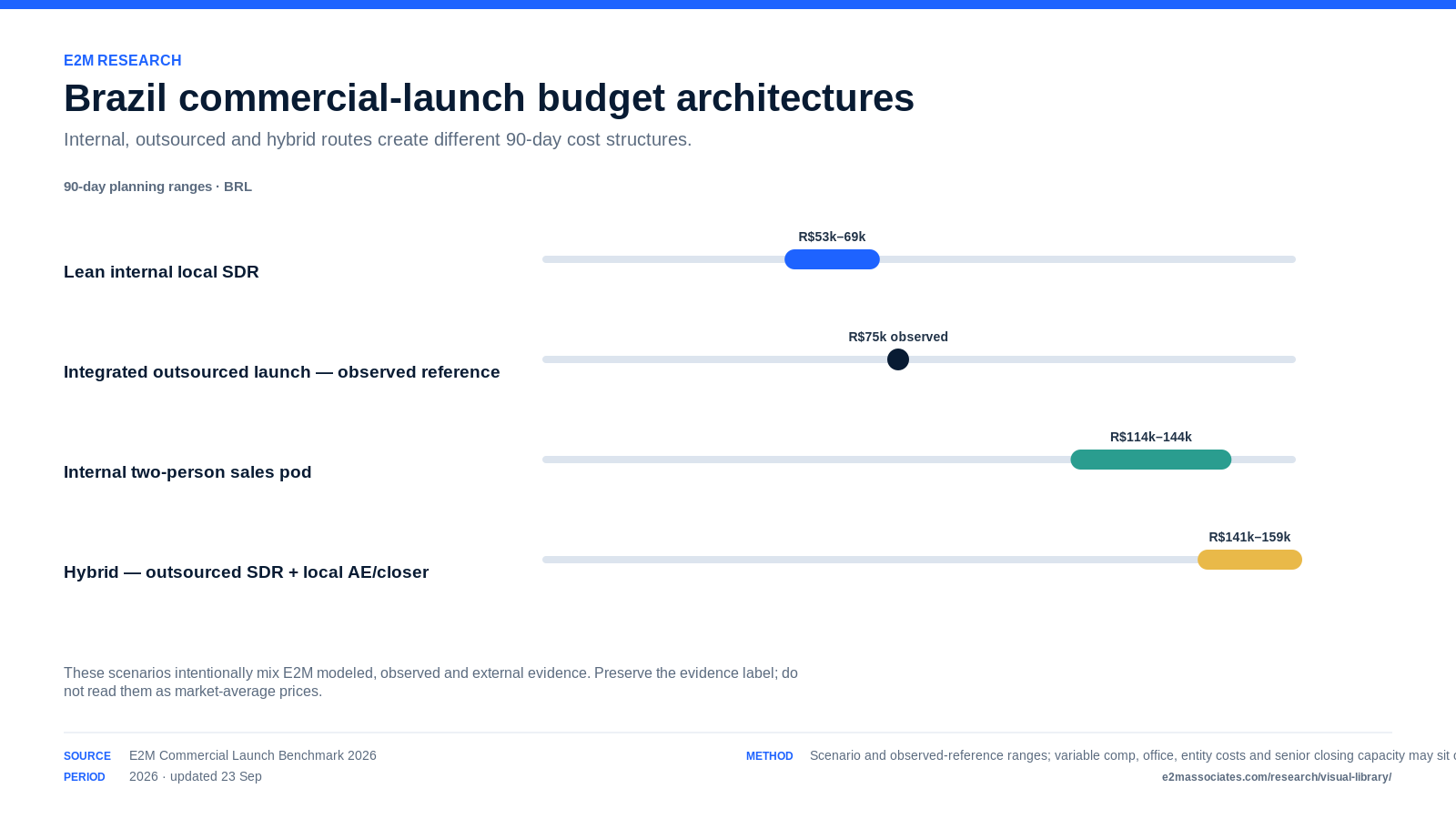
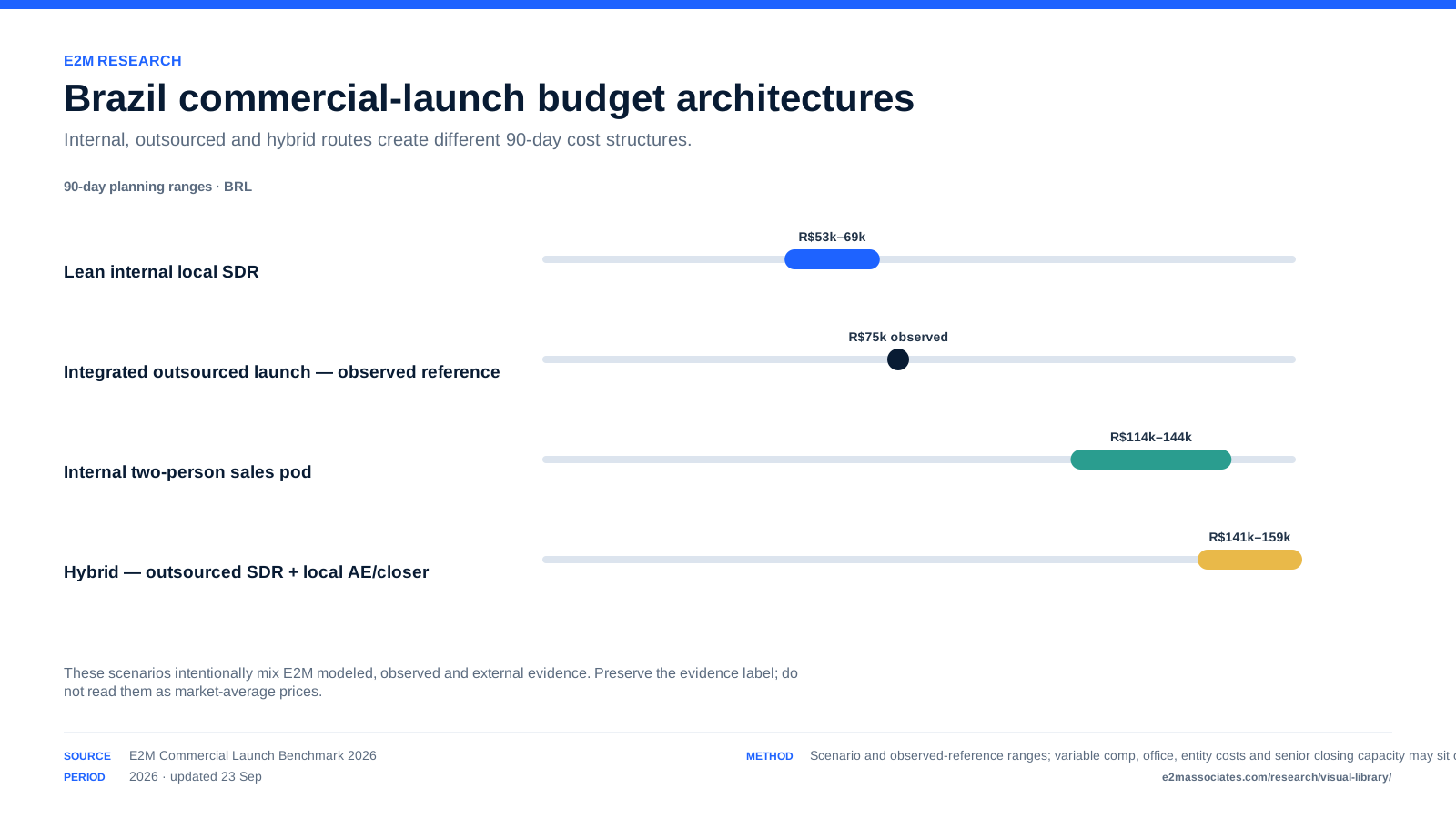
Budget the operating system, not only a salesperson. These scenarios combine current São Paulo salary/employer-cost benchmarks, explicit operating assumptions and one observed E2M program.
Visual scale is illustrative within these four scenarios, not a market percentile.
Excludes: Variable compensation, office, legal/entity costs, paid media and senior closing capacity.
Excludes: No guarantee of meeting output or market-average pricing; HQ/closer time and travel can sit outside scope.
Excludes: Variable compensation, recruiting fee, office, entity setup and marketing production.
Excludes: Variable compensation, recruiting fee, office and entity setup.
Important: The observed R$75k program has a scope target of up to 40 qualified meetings. That target is not guaranteed realized output; dividing R$75k by 40 and calling the result a “Brazil cost per meeting” would be methodologically wrong.
Every number should preserve its evidence label. A case result cannot be treated as a forecast; a software CPL cannot be generalized to industrial sales; an E2M scenario is a planning model, not a quote.
R$75k total / R$25k per month, dedicated SDR, 800 LinkedIn touches/month, 300 WhatsApp touches/month, 300 phone enrichments/month and scope target up to 40 qualified meetings. Current proposal context only.
Agência Maximum reports 30–180 days from first demo to contract across 30+ B2B software clients; MQL→SQL 12–25%, Google+Meta CPL R$80–300 and LinkedIn Ads CPL R$200–600.
Trade.gov recommends Brazil-oriented marketing, close relationships with industry contacts and partners, Portuguese localization, after-sales capability and continuity across negotiations.
Sources are kept separate so readers can audit what is official guidance, survey context, third-party benchmark or E2M observation.