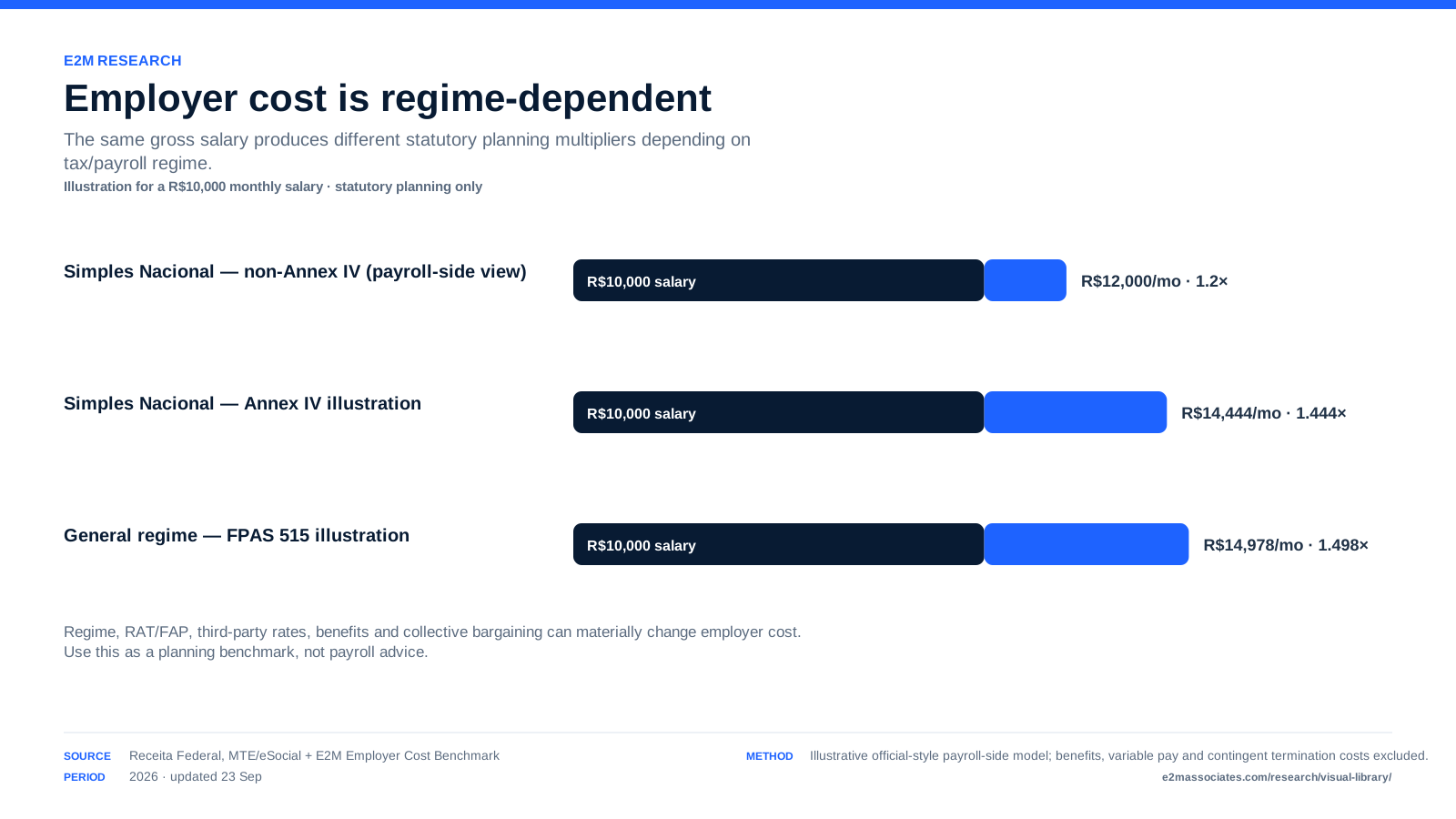
General regime illustration1.50×before benefits · FPAS 515 / RAT 1 / FAP 1.0
Simples Annex IV illustration1.44×before benefits · RAT 2 / FAP 1.0
Simples non-IV1.20×payroll-side view · DAS excluded
Open modelJSON + CSVformula and assumptions inspectable
The direct answer
A R$10,000 salary is not a R$10,000 employer cost.
For a standard full-year CLT employee, the annual budget must add the 13th salary, the constitutional 1/3 vacation premium, FGTS and the employer-side payroll contributions that apply to the company. In an illustrative general-regime FPAS 515 setup with 20% CPP, 1% RAT, FAP 1.0 and 5.8% third-party contributions, the recurring statutory cost is about R$14,978 per month equivalent — 1.50× the gross salary before benefits, variable pay and contingent termination costs.
Critical modeling rule: the paid vacation month is already one of the 12 monthly salaries. The incremental annual vacation cash item is the constitutional 1/3. Counting another full salary for vacation overstates the recurring annual payroll budget.
These are transparent statutory illustrations, not universal employer rates. Benefits are excluded so the payroll architecture remains visible.
Simples — non-Annex IV payroll view1.20×
20.0% above 12 salary months before benefits.
CPP payroll line: 0% in model
FGTS: 8%
DAS revenue taxes excluded
CPP is generally embedded in DAS for non-Annex-IV activities. This is a payroll-side benchmark only; DAS taxes on revenue are outside the calculator.
Simples — Annex IV illustration1.44×
44.4% above 12 salary months before benefits.
CPP: 20%
RAT: 2% illustration
Third parties: 0% in cited example
FGTS: 8%
Illustrative official-style setup using CPP 20% + RAT 2%; actual RAT/FAP depend on activity/establishment.
General regime — FPAS 515 illustration1.50×
49.8% above 12 salary months before benefits.
CPP: 20%
RAT: 1% × FAP 1.0
Third parties: 5.8% illustration
FGTS: 8%
Illustrative commerce/services FPAS 515. Third-party rate and RAT/FAP vary by activity and establishment.
All multipliers assume a full-year employee and apply charges to the modeled covered remuneration. Actual payroll incidence and company classification must be validated.
Interactive model
Employer cost calculator
Enter salary, regime, RAT/FAP, third-party rate and monthly benefits. The model keeps statutory and commercial assumptions separate.
Average monthly employer cost
—
Annual employer cost—
Multiplier—
Above 12 salary months—
Annual breakdown
Planning model, not payroll advice. Collective bargaining, employee-specific facts, special tax rules and corporate taxes can change the result.
Cost architecture
What sits above salary
The right model separates annual cash remuneration, payroll charges, commercial benefits and contingent costs instead of compressing everything into one unexplained percentage.
Component
How to think about it
Layer
12 monthly salaries
Base annual cash compensation
Statutory cash
13th salary
One additional salary for a full year
Statutory cash
Vacation 1/3
Incremental constitutional premium; do not double-count the vacation month
Statutory cash
Employer CPP
General rule 20%; tax-regime treatment varies
Payroll charge
RAT × FAP
RAT 1–3%; FAP 0.5–2.0
Payroll charge
Third-party contributions
FPAS-dependent; 5.8% only as FPAS 515 example
Payroll charge
FGTS
Generally 8%
Payroll charge
Benefits
Company/CBA/specific-rule dependent
Commercial / CBA
Termination / notice
Contingent, not fixed monthly payroll
Contingent
Transparent arithmetic
Worked example: R$10,000 monthly salary
General-regime illustration using FPAS 515, RAT 1%, FAP 1.0 and no benefits. This is the same arithmetic used by the calculator.
Annual component
BRL
12 monthly salaries
R$120.000
13th salary
R$10.000
Vacation 1/3
R$3.333
CPP — 20%
R$26.667
RAT — 1% × FAP 1.0
R$1.333
Third parties — 5.8%
R$7.733
FGTS — 8%
R$10.667
Total statutory annual cost
R$179.733
Average monthly equivalent
R$14.978
This example excludes benefits, variable compensation, recruiting, equipment, EOR/payroll vendor fees and termination contingencies.
Second layer
Benefits and termination are a second layer
Meal/food, health, transport, life insurance and other benefits may arise from company policy, collective bargaining or specific rules. Termination fine, notice and replacement labor are contingent/operational costs — not a fixed recurring payroll rate.
01 · CBA / policy
Benefits are not one universal percentage
Meal/food, health, life insurance, childcare, home-office support and other items can be shaped by collective bargaining or company policy. Use live quotes and the applicable CBA.
02 · Transport
Vale-transporte has a statutory framework
Where applicable, the employee participation is capped at 6% of base salary and the employer covers the qualifying excess. The exact cost depends on the commute.
03 · Contingency
Termination is event-driven
FGTS termination fine, notice and related items depend on how and when employment ends. Keep them as a separate reserve, not as a fake universal monthly tax.
04 · Operations
Vacation can create replacement cost
The vacation month is not another salary, but some operations need temporary coverage. That is an operational capacity cost, separate from statutory payroll.
05 · Variable pay
Sales compensation needs its own layer
Commission and bonus design can materially change employer cost and payroll incidence. Model it from the role plan rather than hiding it inside a generic percentage.
06 · Simples
Payroll-side cost is not total company tax
For non-Annex-IV Simples activity, CPP can sit inside DAS. A low payroll-side multiplier therefore does not mean the business has no social-security cost.
Public methodology
Methodology
The benchmark starts from official legal and payroll rules, then labels scenario assumptions explicitly. It avoids double-counting the vacation month.
1
Start with 12 salary months
Annual base salary already includes the paid vacation month.
2
Add statutory annual cash
Add one 13th salary and the incremental 1/3 vacation premium for a full-year standard case.
3
Apply the company payroll regime
CPP, RAT/FAP and third-party rates depend on tax regime and activity classification.
4
Keep FGTS visible
Model FGTS separately instead of burying it inside an unexplained “burden” percentage.
5
Add benefits and contingencies last
Use company-specific benefits, CBA obligations and a deliberate risk reserve rather than invented universal averages.
Evidence register
Primary sources
Official Brazilian sources anchor statutory percentages and incidence. E2M assumptions are never presented as law.
Tier A · officialReceita Federal — employer social security
20% CPP general rule + RAT 1–3%.
Open source ↗Tier A · officialeSocial — FPAS / third-party rates
FPAS 515 example totals 5.8% for listed commerce/services activities.
Open source ↗Tier A · officialMinistry of Labor — FGTS
Standard employer deposit generally 8%.
Open source ↗Tier A · officialMinistry of Labor — worker rights
13th salary, vacation + 1/3 and vale-transporte framework.
Open source ↗Tier A · officialReceita Federal — Simples Annex IV
Separates CPP treatment inside/outside DAS.
Open source ↗Tier A · officialMinistry of Social Security — FAP
The downloadable JSON records source IDs, formulas, assumptions and exclusions. This benchmark is designed to be auditable rather than to imply a single universal Brazil cost factor.
Turn salary benchmarks into a real Brazil hiring budget.
Use the Salary Benchmark for base pay, this Employer Cost Benchmark for loaded employment cost, and the Brazil Expansion Passport to design the first team.
No. 1.50× is an illustration for a general-regime FPAS 515 employer using RAT 1% and FAP 1.0, before benefits. The exact multiplier changes with tax regime, activity, RAT/FAP, collective bargaining and benefits.
Why do you not add another full salary for vacation?
Because the employee’s paid vacation month is already one of the 12 monthly salaries in the annual salary budget. The incremental annual cash item is the constitutional 1/3 vacation premium. Payroll charges can apply to vacation remuneration and the 1/3 according to the applicable rules.
What changes under Simples Nacional?
For many non-Annex-IV activities, CPP is included in DAS rather than charged separately on payroll. Annex IV is different and CPP is paid outside DAS. This benchmark keeps those cases separate and does not treat DAS taxes on revenue as payroll cost.
Are meal vouchers and health insurance mandatory?
Not universally as one federal fixed package. Benefits can be driven by collective bargaining, company policy or specific rules. Vale-transporte has its own statutory framework. Always check the applicable collective agreement.
Does the calculator include termination cost?
Only if you add an optional contingency reserve. Termination fine, notice and related items depend on the termination event and are not modeled as a universal recurring monthly charge.
E2M Research
Related research
Continue from salary to loaded employment cost, first-team design and wider market-entry economics.