E2M RESEARCH · CUSTO DO EMPREGADOR · 2026

Benchmark de Custo do Empregador no Brasil 2026

Quanto um empregado no Brasil realmente custa para a empresa além do salário bruto?

Atualizado em 23 set 2026Benchmark de planejamento CLTRegras oficiais separadas de premissas E2MCalculadora + dados abertos
Ilustração de regime geral1.50×before benefits · FPAS 515 / RAT 1 / FAP 1.0
Simples Annex IV illustration1.44×before benefits · RAT 2 / FAP 1.0
Simples non-IV1.20×payroll-side view · DAS excluded
Open modelJSON + CSVformula and assumptions inspectable
Resposta direta

Um salário de R$10.000 não custa R$10.000 para o empregador.

Para um empregado CLT durante um ano completo, o orçamento precisa adicionar 13º salário, terço constitucional de férias, FGTS e as contribuições patronais aplicáveis à empresa. Em uma ilustração de regime geral com FPAS 515, CPP de 20%, RAT de 1%, FAP 1,0 e terceiros de 5,8%, o custo estatutário recorrente equivale a cerca de R$14.978 por mês — 1,50× o salário bruto antes de benefícios, variável e custos contingentes de desligamento.

Critical modeling rule: the paid vacation month is already one of the 12 salários mensais. The incremental annual vacation cash item is the constitutional 1/3. Counting another full salary for vacation overstates the recurring annual payroll budget.
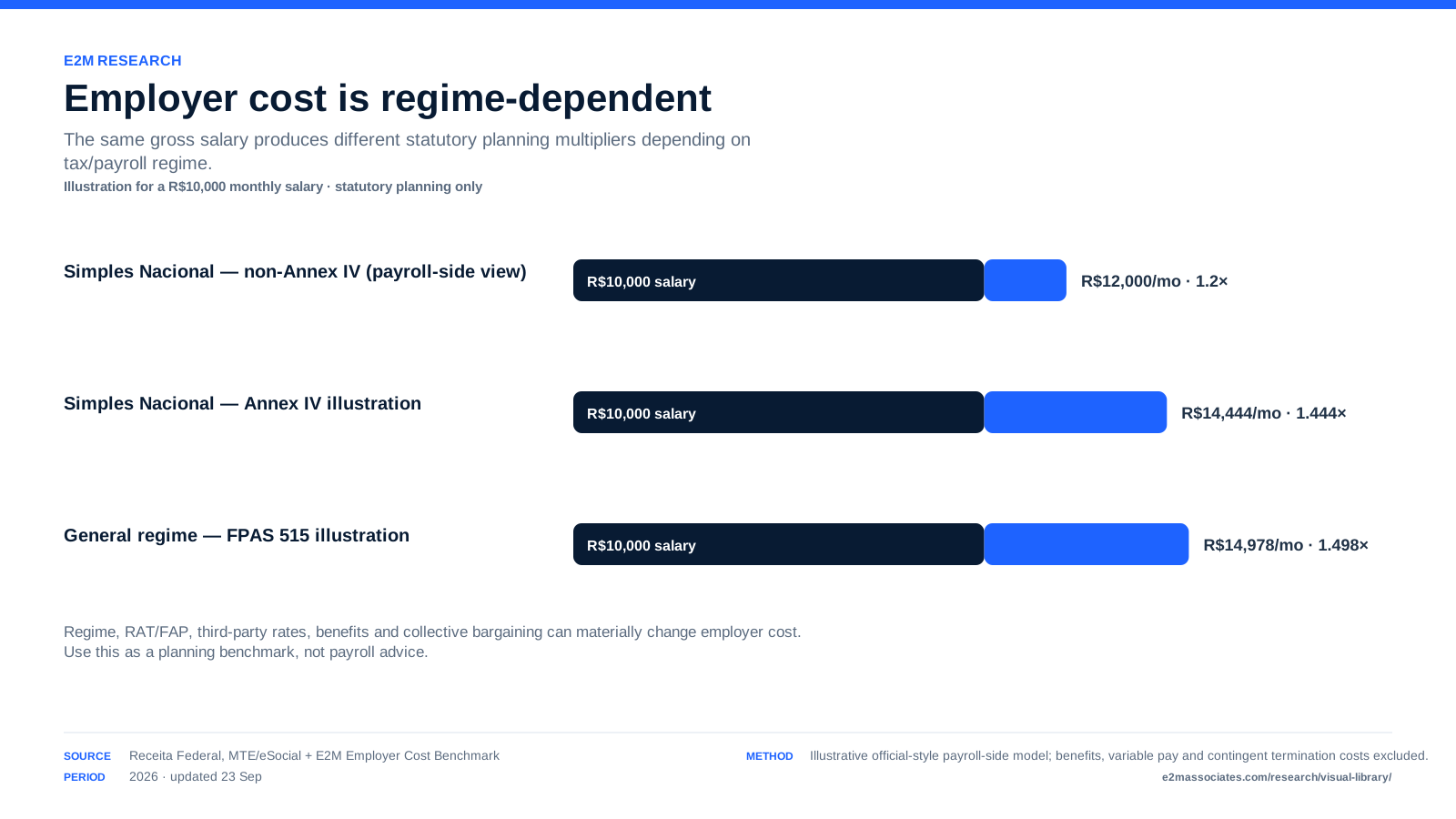
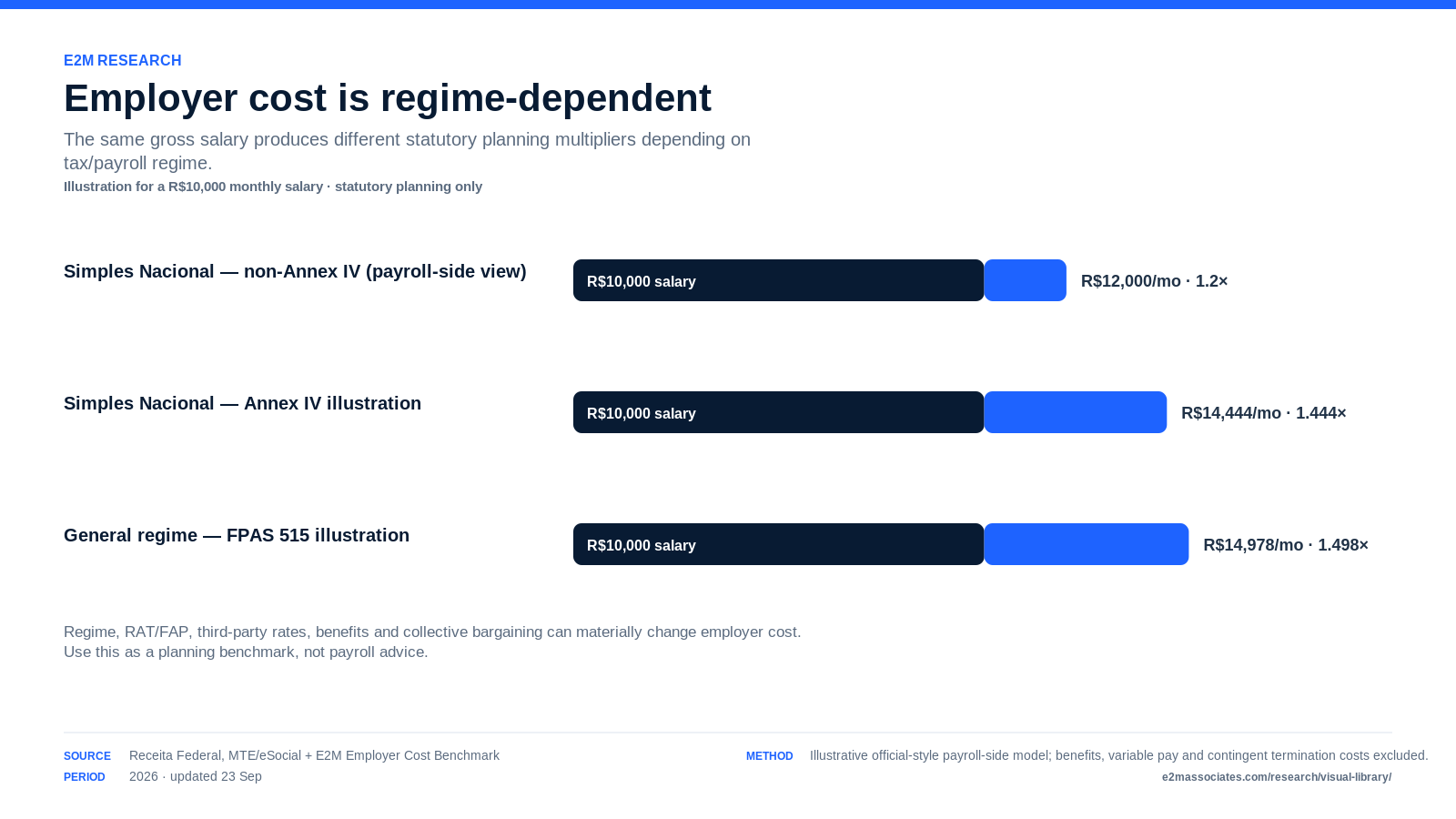
Barras comparam ilustrações de custo empregador estatutário entre regimes tributários e de folha selecionados no Brasil.
Brazil Employer Cost — Regime Illustrations
Source: Receita Federal, MTE/eSocial + E2M benchmark · Period: 2026 · updated 23 Sep · Method: R$10k salary illustration; regime-specific statutory planning factors, not universal payroll multipliers.
Arquitetura estatutária

Três arquétipos úteis de planejamento

São ilustrações estatutárias transparentes, não alíquotas universais. Benefícios ficam fora para deixar a arquitetura da folha visível.

Simples — fora do Anexo IV (visão folha)1.20×

20.0% above 12 salary months before benefits.

  • CPP payroll line: 0% in model
  • FGTS: 8%
  • DAS revenue taxes excluded

CPP is generally embedded in DAS for non-Annex-IV activities. This is a payroll-side benchmark only; DAS taxes on revenue are outside the calculator.

Simples — ilustração Anexo IV1.44×

44.4% above 12 salary months before benefits.

  • CPP: 20%
  • RAT: 2% illustration
  • Third parties: 0% in cited example
  • FGTS: 8%

Illustrative official-style setup using CPP 20% + RAT 2%; actual RAT/FAP depend on activity/establishment.

Regime geral — ilustração FPAS 5151.50×

49.8% above 12 salary months before benefits.

  • CPP: 20%
  • RAT: 1% × FAP 1.0
  • Third parties: 5.8% illustration
  • FGTS: 8%

Illustrative commerce/services FPAS 515. Third-party rate and RAT/FAP vary by activity and establishment.

Todos os multiplicadores assumem um empregado durante o ano completo e aplicam encargos sobre a remuneração modelada. A incidência real e a classificação da empresa devem ser validadas.

Modelo interativo

Calculadora de custo do empregador

Informe salário, regime, RAT/FAP, terceiros e benefícios mensais. O modelo separa obrigações estatutárias de premissas comerciais.

Custo médio mensal do empregador
—
Custo anual do empregador—
Multiplicador—
Acima de 12 salários—
Composição anual
Modelo de planejamento, não orientação de folha. Convenções coletivas, fatos específicos do empregado, regras tributárias especiais e impostos corporativos podem alterar o resultado.
Arquitetura de custos

O que existe acima do salário

O modelo correto separa remuneração anual, encargos de folha, benefícios comerciais e custos contingentes em vez de esconder tudo em um percentual único.

ComponentComo interpretarCamada
12 salários mensaisBase annual cash compensationStatutory cash
13º salárioOne additional salary for a full yearStatutory cash
Terço constitucional de fériasIncremental constitutional premium; do not double-count the vacation monthStatutory cash
CPP patronalGeneral rule 20%; tax-regime treatment variesPayroll charge
RAT × FAPRAT 1–3%; FAP 0.5–2.0Payroll charge
Contribuições a terceirosFPAS-dependent; 5.8% only as FPAS 515 examplePayroll charge
FGTSGenerally 8%Payroll charge
BenefíciosCompany/CBA/specific-rule dependentCommercial / CBA
Termination / noticeContingent, not fixed monthly payrollContingent
Cálculo transparente

Exemplo: salário mensal de R$10.000

Ilustração de regime geral com FPAS 515, RAT 1%, FAP 1,0 e sem benefícios. É a mesma matemática usada na calculadora.

Componente anualBRL
12 salários mensaisR$120.000
13º salárioR$10.000
Terço constitucional de fériasR$3.333
CPP — 20%R$26.667
RAT — 1% × FAP 1.0R$1.333
Third parties — 5.8%R$7.733
FGTS — 8%R$10.667
Total statutory annual costR$179.733
Average monthly equivalentR$14.978

This example excludes benefits, variable compensation, recruiting, equipment, EOR/payroll vendor fees and termination contingencies.

Segunda camada

Benefícios e desligamento são uma segunda camada

Alimentação, saúde, transporte, seguro de vida e outros benefícios podem decorrer da política da empresa, convenção coletiva ou regras específicas. Multa rescisória, aviso e reposição durante férias são custos contingentes/operacionais — não uma alíquota recorrente fixa.

01 · CBA / policy

Benefícios are not one universal percentage

Meal/food, health, life insurance, childcare, home-office support and other items can be shaped by collective bargaining or company policy. Use live quotes and the applicable CBA.

02 · Transport

Vale-transporte has a statutory framework

Where applicable, the employee participation is capped at 6% of base salary and the employer covers the qualifying excess. The exact cost depends on the commute.

03 · Contingency

Termination is event-driven

FGTS termination fine, notice and related items depend on how and when employment ends. Keep them as a separate reserve, not as a fake universal monthly tax.

04 · Operations

Vacation can create replacement cost

The vacation month is not another salary, but some operations need temporary coverage. That is an operational capacity cost, separate from statutory payroll.

05 · Variable pay

Sales compensation needs its own layer

Commission and bonus design can materially change employer cost and payroll incidence. Model it from the role plan rather than hiding it inside a generic percentage.

06 · Simples

Payroll-side cost is not total company tax

For non-Annex-IV Simples activity, CPP can sit inside DAS. A low payroll-side multiplier therefore does not mean the business has no social-security cost.

Metodologia pública

Metodologia

O benchmark parte de regras oficiais de trabalho e folha e rotula claramente as premissas de cenário. Evita contar o mês de férias duas vezes.

1

Start with 12 salary months

Annual base salary already includes the paid vacation month.

2

Add statutory annual cash

Add one 13º salário and the incremental 1/3 vacation premium for a full-year standard case.

3

Apply the company payroll regime

CPP, RAT/FAP and third-party rates depend on tax regime and activity classification.

4

Keep FGTS visible

Model FGTS separately instead of burying it inside an unexplained “burden” percentage.

5

Add benefits and contingencies last

Use company-specific benefits, CBA obligations and a deliberate risk reserve rather than invented universal averages.

Registro de evidências

Fontes primárias

Fontes oficiais brasileiras sustentam percentuais e incidências estatutárias. Premissas E2M nunca são apresentadas como lei.

Tier A · officialReceita Federal — employer social security

20% CPP general rule + RAT 1–3%.

Abrir fonte ↗
Tier A · officialeSocial — FPAS / third-party rates

FPAS 515 example totals 5.8% for listed commerce/services activities.

Abrir fonte ↗
Tier A · officialMinistry of Labor — FGTS

Standard employer deposit generally 8%.

Abrir fonte ↗
Tier A · officialMinistry of Labor — worker rights

13º salário, vacation + 1/3 and vale-transporte framework.

Abrir fonte ↗
Tier A · officialReceita Federal — Simples Annex IV

Separates CPP treatment inside/outside DAS.

Abrir fonte ↗
Tier A · officialMinistry of Social Security — FAP

FAP range 0.5–2.0 applied to RAT.

Abrir fonte ↗

The downloadable JSON records source IDs, formulas, assumptions and exclusions. This benchmark is designed to be auditable rather than to imply a single universal Brazil cost factor.

Transforme salário em um orçamento real de contratação no Brasil.

Use o Salary Benchmark para salário-base, este Employer Cost Benchmark para custo carregado e o Brazil Expansion Passport para desenhar o primeiro time.

FAQ

FAQ

Interpretação, escopo e limites de planejamento.

O custo do empregador é sempre 1,50× o salário?

Não. 1,50× é uma ilustração para regime geral FPAS 515 com RAT 1% e FAP 1,0, antes de benefícios. O multiplicador muda conforme regime tributário, atividade, RAT/FAP, convenção coletiva e benefícios.

Por que não somar outro salário inteiro de férias?

Porque o mês de férias remuneradas já faz parte dos 12 salários mensais do orçamento anual. O item incremental é o terço constitucional. Encargos podem incidir sobre a remuneração de férias e o terço conforme as regras aplicáveis.

O que muda no Simples Nacional?

Para muitas atividades fora do Anexo IV, a CPP está no DAS em vez de ser cobrada separadamente sobre a folha. O Anexo IV é diferente e recolhe CPP fora do DAS. O benchmark separa os casos e não trata tributos do DAS sobre receita como custo de folha.

Vale-refeição e plano de saúde são obrigatórios?

Não existe um pacote federal fixo universal. Benefícios podem decorrer de convenção coletiva, política da empresa ou regras específicas. Vale-transporte possui regime legal próprio. Verifique sempre a CCT aplicável.

A calculadora inclui custo de desligamento?

Somente se você inserir uma reserva contingencial opcional. Multa, aviso prévio e itens relacionados dependem do evento de desligamento e não são tratados como encargo mensal universal.

NOVA PESQUISA

Brazil First-Team Benchmark 2026

BENCHMARK

1 · 3 · 5 · 10 pessoas no primeiro time

Estruturas SaaS, serviços, industrial e comercial com ordem de contratação, planejamento P50 de salário/custo e decisões make-vs-buy.

Abrir benchmark →
PESQUISA DE CONTRATAÇÃO

Benefícios para empregados no Brasil →